


No doubt many of you are thinking that “sovereign wealth funds” are for countries with huge surpluses, usually windfalls from the exploitation of resources like oil or gold. For countries with stupendous piles of debt, the best thing to do for the health of their economies is to devote resources to paying down the debt, which at this writing stands at $38 trillion and growing every day. Trump’s first year back in office added $1.8 trillion to that total and is projected to add at least $2 trillion per year into the future. You can check where it stands in real time.
The total debt is nearly 120% of the entire US Gross Domestic Product. Annual interest payments now consume $1.2 trillion – that’s your tax money going into the Treasury and then straight back out to pay the interest on the debt accumulated over time. Small wonder paying taxes feels like a bad deal – about 25 cents of every tax dollar goes to service old debt, so taxpayers are getting (at most) 75 cents of government services for every dollar they pay in. Those interest payments now exceed the entire budget for the Pentagon. And this mountain of old debt has all kinds of additional bad consequences for the economy. J.P. Morgan’s chief strategist warned that the global financial markets are acutely aware that the US “is going broke slowly.” (One can’t help thinking of Hemingway’s The Sun Also Rises: “How did you go bankrupt?” Bill asked.“Two ways,” Mike said. “Gradually and then suddenly.”)
It is just plain foolish, many argue, to raise large sources of new revenue and devote it to anything other than retiring some of this debt. If you’re one of those readers imagining using piles of new revenue to make a dent in our national debt, we owe you an acknowledgement: You are objectively correct. If an avalanche of additional revenue fell into the US Treasury tomorrow, the right response would be to devote it to paying down our outsized national debt. Full stop.
You are also delusional. Or at least naive. Any shrink worth her salt will tell you the best predictor of future behavior is past behavior. The debt problem has been growing decade after decade, and we have managed to do exactly nothing about it. All of the incentives built into our government’s decision-making structure run counter to dealing with the debt. Our current political system is engineered to respond to crises, not to economic abstractions like the national debt. There is zero reason to expect any of that will change in the future. If you can figure out a plan to galvanize overwhelming citizen support for paying down the debt, we’re all for it. Best of luck.
The opposite is true for the National Endowment. Much like the Alaska Permanent Fund, the endowment will galvanize citizen support because every citizen will own a named account that gives her a stake in the American economy. Every year, she will get a distribution from the National Endowment that will make her life easier and help her to pay her bills and raise a family. She will know that in hard times, she has an insurance policy she can fall back on. And much like the Alaska Permanent Fund or Social Security, the National Endowment will become sacrosanct. Over time the funding decisions for the endowment will become more and more attractive to ordinary citizens and voters.
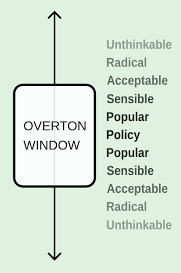
The term Overton window describes the limits of what is politically possible in any given moment. Within the window, we see the range of ideas, policies, or views that are considered politically acceptable or viable in the mainstream. Politicians pay close attention to the ways in which this window shifts over time – and to the events, movements, and tactics that cause those shifts. The nonviolent civil rights movement – and Martin Luther King’s “I have a dream” speech – shifted the Overton window on race relations in the United States in the 1960s. The abuses of monopolies and the excesses of the Gilded Age made possible the idea of a Constitutional amendment to allow an income tax in the early 1900s. The attack on Pearl Harbor radically shifted the Overton window on US involvement in WWII. The carnage of war in Vietnam – the first televised war – shifted American consensus decisively away from wars of foreign intervention for at least a generation.
Usually, the Overton Window follows public sentiment, rather than driving it. Yet sometimes, the enactment of a policy itself shifts the Overton window. The temperance movement led to the passage of a Constitutional amendment banning alcohol, yet the lived realities of Prohibition shifted public sentiment dramatically enough to force repeal just 13 years later.

We believe the adoption of a National Endowment will shift the Overton window when it comes to funding sources. Once people start receiving regular distribution checks, their attitudes toward additional funding sources for the growth of the fund will evolve. Try getting Alaskans to consider reducing the royalties on oil and gas extraction in their state . . . if you dare. (And then try getting seniors to accept cuts in Medicare or Social Security to pay down the national debt they racked up.)
Without the egregious wealth inequality of present-day America (best caricatured by the ludicrous one-upsmanship of billionaires in space), the increasing gap between those who own and those who labor, the advent of AI-augmented automation, and the heartlessness of the Trump Administration, it is unlikely we would ever have proposed the National Endowment. Those factors shifted the Overton window decisively toward ideas that level the playing field and give everyone a fair stake in the riches of this nation.
As the National Endowment becomes an accepted feature of the American economy, people will shift their attitudes toward the funding sources. The Carbon Dividend Plan is the best policy idea of this generation, yet it has gained no traction in the popular mind. That may well change when people understand carbon emissions assessments as a way of funding expansion of the National Endowment.
If you can think of a way to shift the Overton window on the national debt, bring it on. In the meantime, we ask you to read the following posts on the range of possible funding sources through the Overton window.