
Shared Prosperity, Shared Purpose
The right is circling national service and common ownership


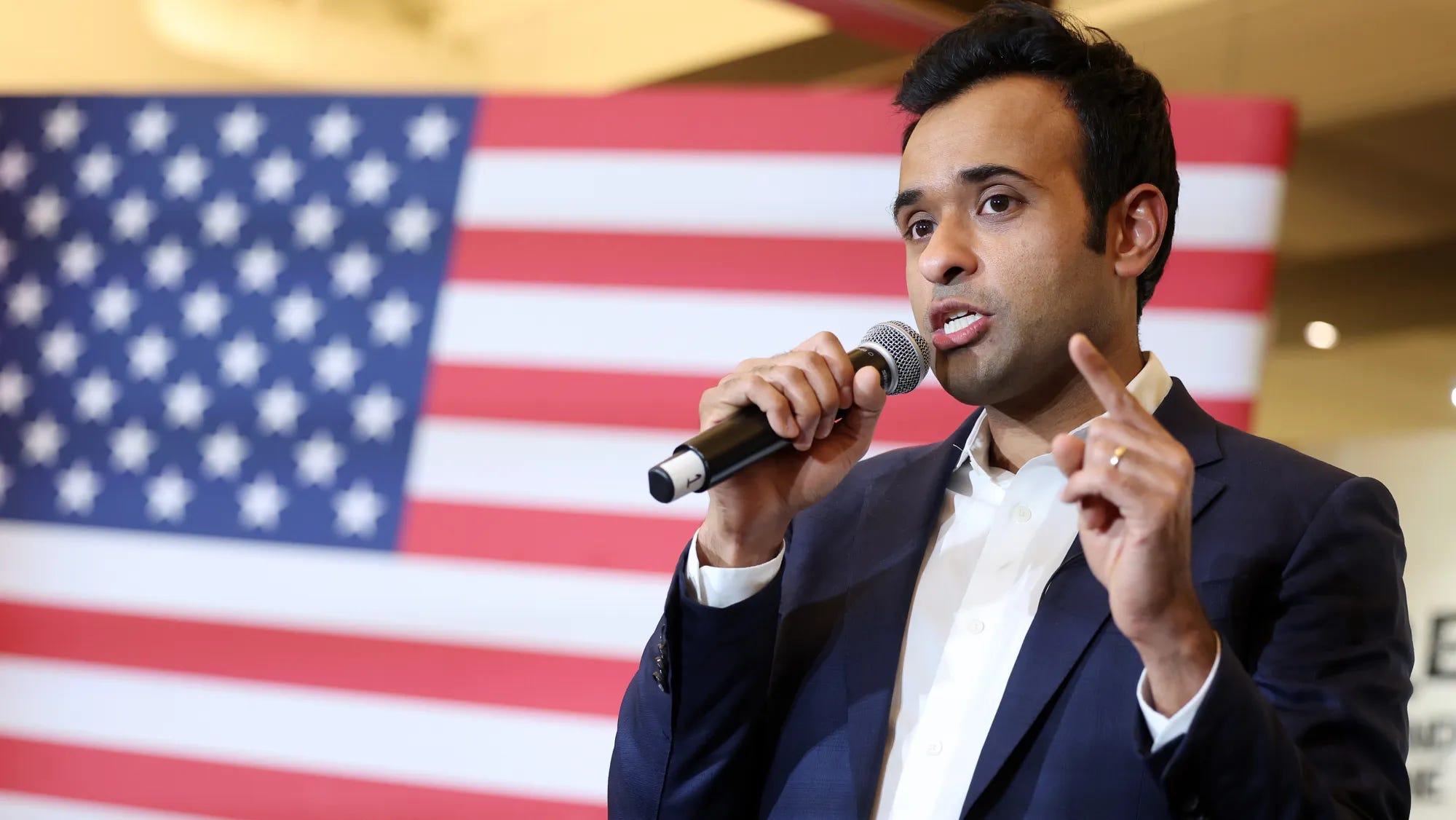
Vivek Ramaswamy wrote a Christmas New York Times op-ed outlining two incompatible visions of American identity, the source of an emerging conflict threatening the American right. Vivek’s favored vision is rooted in our shared belief in a set of ideals: democracy, freedom, rule of law, individual liberty, and equality of opportunity. The opposing identity, “heritage Americans,” as its adherents are fond of calling themselves, is about family trees. Vice President Vance stated this principle succinctly last summer: “I think the people whose ancestors fought in the Civil War have a hell of a lot more claim over America than the people who say they don’t belong.” Vance boasts of having 7 generations of ancestors buried in an Eastern Kentucky graveyard as evidence of his superior claim to be the rightful heir to the “homeland.” Tellingly, Vance fails to specify which side of the Civil War qualifies you to be an American; he is descended from two notable Confederate officials: a Governor and a Brigadier General, men who openly betrayed the lofty principles on which the American Republic was founded. Small wonder he hopes Identity #2 wins out.
Which version of the American identity serves better to renew the belief that “we’re all in this together” is a topic we’ll visit frequently. For now, though, Vivek’s diagnosis of right-wing identity politics is not what stands out. His prescription for the GOP is what caught our attention. Vivek ends up arguing for something that looks an awful lot like the National Endowment, or at least a cousin of it. He also touches on the need for a “shared national project” aimed at giving Americans a shared purpose, a foreshadowing of a future subject of this Substack: Universal National Service.
Shared Prosperity
Vivek’s economic proposal is to “create broad-based participation in wealth generation from stock market gains.” He reasons that “in the A.I. era, it’s conceivable to envision a future with stock market outperformance even in the face of stagnating wages and job losses. That is a formula for social unrest, and shared equity offers a practical solution.” Several great points there. If A.I. delivers on its promise to make millions of routine, repetitive knowledge worker jobs obsolete, we could see skyrocketing share values alongside escalating unemployment and downward pressure on wages – a “productivity recession.” And, yes, that sort of toxic unfairness is a perfect recipe for social upheaval.
Regrettably, Vivek’s solution, which is a variation on Trump’s baby bonds, is unworkable and ineffective: “If every kid legally born in the United States receives an ‘American dream birthright’ in the form of $10,000 invested in the S&P 500, every young American would become a millionaire by age 60.” This is little more than a gesture in the right direction. First, where will that money come from? Vivek never specifies the source for that $10,000 per kid, or nearly $40 billion per year. Second, what does funding 60-year-olds in 2086 do for the hundreds of millions of American families who are struggling today? Finally, that “million dollars” in 2036 has a present value of only $30,000 today.
We’ve argued that one key advantage of the National Endowment is its ability to shift the Overton Window. As citizens enjoy those growing annual dividend checks, they will become more deeply committed to expanding the National Endowment through commonsense reforms such as a Carbon Dividend, an estate tax threshold below $30 million, and policies that treat labor on equal terms with capital. A proposal that benefits no one for three generations does nothing to change political attitudes today.
Even if the specific proposal is dopey, the insight behind it is profound. “Shared equity” does indeed offer a practical and powerful solution to our accelerating problem of inequality. The increase in share prices in the Magnificent 7 companies leading the AI revolution has increased the wealth of their already wealthy shareholders by $6.25 trillion in the past 2 years. If that wealth had been owned by a broad swath of American families, every American household would be nearly $50,000 richer. That is the core intuition behind the National Endowment. If we anchor citizens to a common source of prosperity, we can restore the sense that “we’re all in this together.” We could restore that mid-century era of collective identity that Robert Putnam so brilliantly describes in The Upswing: a period when rising growth coincided with falling inequality, and when national success felt participatory, not extractive or exclusive. Vivek exults, “Young Americans on the left and right alike would have shared skin in the game to root together for maximal economic growth.” Replace “young” with “all,” and you have the base case for the National Endowment.
It’s worth pausing on the strange and promising convergence between the Sanders left and Trump’s industrial policy advocates on the right. Both somehow love the idea of the government being the largest shareholder in Intel and grabbing a slice of Nvidia’s profits from selling advanced semiconductor chips to China. The beauty of the National Endowment is its surprising political feasibility and ability to entice those on both sides of the aisle. For Democrats, it tackles inequality without permanent dependency, subject to the whims of Congress. For conservatives, the National Endowment has the potential to save capitalism from its own excesses.
We don’t need to fear a future dominated by robots enabled with discernment through A.I… as long as we all own the robots.
Shared Purpose
Vivek laments the collapse of a shared national identity capable of withstanding generational pessimism and cultural fragmentation. In that vacuum, he says young Americans are turning toward Nick Fuentes’ Groyperism on the right and Mamdani-infused socialism on the left. We agree that those are both bad choices. Vivek wisely understands that broader economic participation can’t, by itself, reweave America’s frayed social fabric. So he has another proposal: He wants America to engage in a shared national project – “a modern-day equivalent of the Apollo mission.” He doesn’t specify what this project will be, though he takes an admirably big swing:
“Perhaps it’s establishing a base on the moon to achieve nuclear fusion in a way that powers the creation of artificial intelligence without negative externalities and constraints on Earth.”
Nothing wrong with having big dreams, but that one may take us into the realm of pure imagination. Yet the instinct is spot on: Because we come from so many diverse nationalities, cultures, and traditions, Americans need a basis to feel bound to one another. In prior generations, that sometimes took the form of an external enemy: a tyrannical king, a fascist threat of world domination, or an ideological foe in Communism. Americans rise to the challenge when we are thrown together to combat a common adversary. Our petty differences melt away, and our shared beliefs and ideals shine brighter. So, how to accomplish those ends without fighting a war (cold or hot)?
We believe we can do it through a program of Universal National Service (UNS) in which young Americans come together to serve our nation in the military, hospitals, education, fire and EMS services, child care, and other forms of productive service in one unified corps built on our core values as a people, leavened with our natural compassion and spirit of generosity.
UNS unites people in pursuit of a common goal and a shared sense of purpose. The practical effect of Americans physically coming together breaks down barriers, promotes mutual understanding, builds cross-cultural friendships, and strengthens our shared values. Those reinforced values then serve as the sturdy foundation for lifelong participation as citizens in our democracy and as contributors in our free market economy – both of which depend upon a people with robust morals and principles.
Beyond those aspirational goals, UNS is also a training ground for the skills of emotional intelligence (EQ) and conflict management that will be most important in a world of accelerating change and advancing technology.
In further posts, we will detail the arguments for national service, as well as the long-overlooked implementation of such a program.
We don’t agree with Vivek on much. But it’s helpful and heartening to find common ground with someone on the far side of the political spectrum. It gives us hope that we can find political support for these ideas and someday renew the strong conviction that “we’re all in this together.”