We hear no shortage of diagnoses of America’s problems today. Books from Abundance to Upswing to Our Own Worst Enemy to How Democracies Die all do a fine job of explaining where we’re going wrong.1 Our job here is to build on that collective wisdom to figure out how we get back on track and to renew the shared conviction that “we’re all in this together.” Today, we introduce a cornerstone of that initiative: a “National Endowment” designed to give every American citizen a meaningful stake in the success of our economy.
American capitalism, the most powerful wealth-creating machine in history, has drawn a sharp distinction between the owners of capital (money, land, factories, and other productive resources) and those who earn their income solely from labor. Profits flow to those who put their capital at risk in productive ventures; those profits are amplified by preferential “capital gains” tax treatment and the magic of compound interest. Workers who have nothing to offer but their time, talent, and sinew face an alternate reality. Their rewards are fixed by the labor market and bounded by the hours in a day.
Democrats run their usual playbook, aiming to shift the balance of rewards from capital to labor: raising the minimum wage, strengthening the hand of unions in collective bargaining, and expanding social welfare programs. But tweaks at the margin that do not shift the fundamental imbalance. It’s past time to break down the boundary between capital and labor and finally deal everyone into the (stacked) deck of capital ownership.
We can accomplish that by creating a large investment fund that would gradually buy up shares (and other securities) in US corporations. Every American would own an equal stake in our National Endowment.
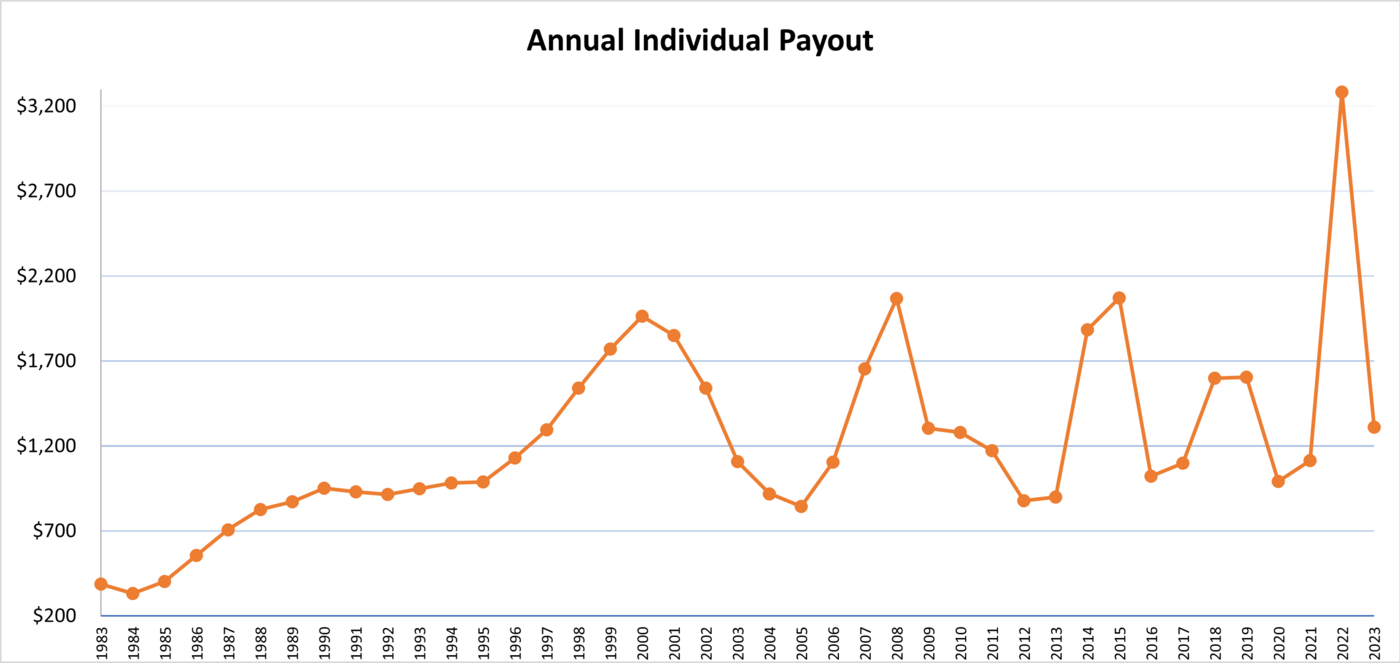
The people of Alaska invented a novel way to share their wealth 50 years ago. The Alaska Permanent Fund collects a royalty payment on every barrel of oil or cubic foot of natural gas that is pumped out of public lands in Alaska. Most of that revenue is distributed as an annual dividend check to every resident of Alaska. The rest is invested for future generations. The payout fluctuates with prices and production each year, but has averaged around $1500 - $1700 per resident per year. Alaskans have come to count on that income to supplement their earnings – as they should. After all, the oil and gas belong to them. The State simply holds those resources in trust for the public. And woe to any politician who so much as whispers about holding back on those checks.
We propose creating a parallel system on a national scale, one that, like Alaska’s Permanent Fund, ensures the wealth generated from shared resources flows back to the people. The modern resource driving immense prosperity is the advent of artificial intelligence (AI). On current course and speed the bulk of that value will accrue to the shareholders of a dozen global mega-companies that are poised to dominate this new era, while the costs of lost jobs and dislocation will be borne by displaced workers.
Ezra Klein lays out a beautiful vision in the utopian opening chapter of Abundance: “Because AI is based on the collective knowledge of all humankind, its benefits are shared.” The passive voice is doing a whole lot of work in that aspirational sentence. Klein fails to explain how those benefits would be shared. Through the National Endowment, every American citizen would have a stake in those global mega-companies, and the benefits truly would be shared. We don’t need to fear the future dominated by highly productive robots, as long as we all own the robots.
Mechanics
The National Endowment will be a substantial fund invested in American corporations, whose earnings are shared equally among all citizens. This institution would allow all American citizens to share in the spectacular benefits of our thriving free-market capitalist economy.
Here is how we make it happen:
Every child born or a citizen naturalized in the United States will be granted 1,000 shares (an arbitrary number) in their individually named account, through which they will have an equal claim on the Endowment’s earnings.
The Endowment will invest primarily in American companies with share ownership capped at 20% of the enterprise value of any individual company. Importantly, these stakes would never come with political strings attached.
The fund will be managed like a university endowment or a pension fund, with a professional staff allocating money to outside managers across a variety of asset classes. Like other private endowments, the fund might take advantage of opportunities to invest in private equity, securitized debt, or other financial instruments that are difficult to access for individual investors.
A portion of the earnings flowing from these investments will be distributed annually as a dividend, deposited directly into every citizen’s account to save, invest, or spend as they see fit. These dividends would not replace wages. They would provide supplemental income for every American citizen as their birthright and recompense for active participation in our democracy.
The base 1,000 shares will not be transferable and will revert to the National Endowment upon death, to be granted to the next newly eligible citizen.
Funding
The National Endowment shares will be bought for fair value on the open market. We do not advocate any form of nationalization, seizure of property, or socialist takeover of American corporations – and remember, we propose limiting ownership to 20% of any individual corporation. To protect against undue political influence on business decisions, we have considered whether the National Endowment should own non-voting shares. More on the pros and cons of that choice in a future Substack.
We have considered a range of potential funding sources for the National Endowment. The place to start with funding is better management of the assets and resources currently held in trust by the government for the benefit of the public: mining rights, timber rights, grazing rights, mineral extraction rights, IP generated via public R&D investment, the broadcast spectrum, seabed leases, wind power rights, etc. Too often, these resources are sold, leased, or given away in the name of “economic development.” That may have been a good idea for a nascent nation with a frontier to conquer, but it has no place in our time. The system has devolved into yet another form of welfare for big corporations. The government should think and act like a resource owner and demand fair market value for all of the assets it leases or sells to corporations. The proceeds from those assets should rightly flow to their true owners – the American people, not to their government’s coffers.
An extension of that same principle is to take possession of the equity and other securities obtained through government bailouts of private industry, like the massive rescues of Wall Street banks and auto giants in 2008. Those shares acquired through the disposition of hundreds of billions in public funds should be contributed directly to the National Endowment.
We promise to discuss these and several other funding sources in later Substacks. But the need for a National Endowment stands independent of any particular source of funding. Today we face a compelling need to renew the sense of participation and mutual benefit in our economic life – a conviction that “we’re all in this together.” However we decide to raise the funds, the concept of the National Endowment stands on its own merits.
Parallels
This idea has many parallels in our existing economy. In fact, if the Federal Reserve and the investment behemoth BlackRock had a love child, it would be the National Endowment. From one parent, it would inherit professionalism, political independence, a fierce commitment to a well-defined mandate, and a strong commitment to the public good. From the other, it would gain the scale, discipline, and investment acumen needed to ensure stability and long-term growth. Like both of them, the National Endowment will have a crisply defined mandate to maximize the growth of the fund, not to mix politics and business.
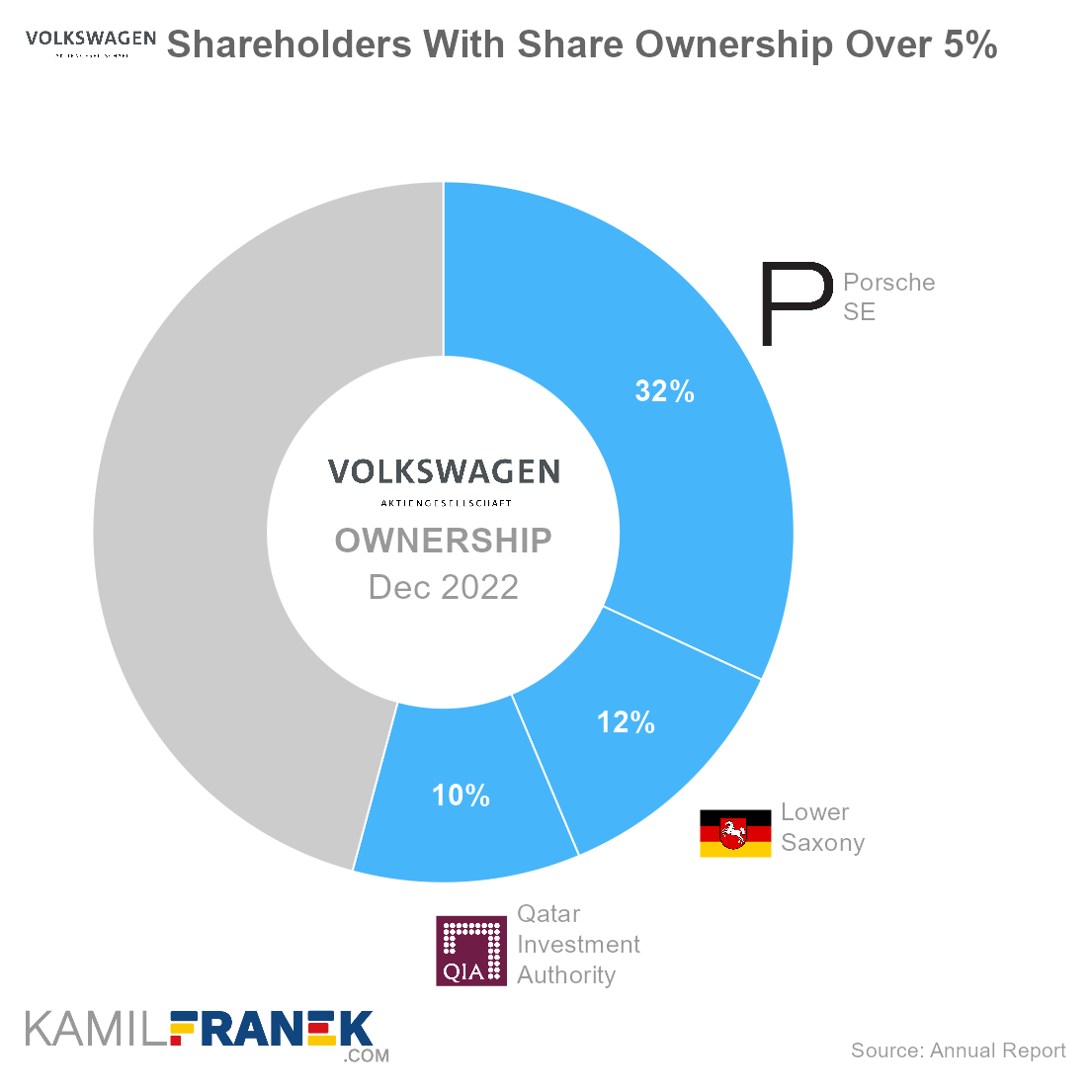
The State of Lower Saxony in Germany has owned a minority stake in Volkswagen since 1960. It holds about 12% of Volkswagen’s shares and 20% of the voting rights. Yet the government has remained steadfast in its focus as a shareholder, never letting political considerations undermine the priority of generating a strong return for its citizens. The two supervisory directors appointed by Lower Saxony and the additional directors representing labor have come to think like owners, balancing the needs of all stakeholders with a steady eye on profits.2
Direct ownership of corporations by governments is commonplace in Europe, China, Africa, and many parts of the Arab world. France and Germany own significant stakes in Airbus that have not hindered that company’s ability to compete effectively with Boeing.
Ownership of our country’s largest publicly traded companies has spread gradually into American life for decades, through pension funds, life insurance policies, mutual funds, 401(k) plans, IRAs, Section 529 College Savings Plans, ETFs (exchange traded funds), you name it. The National Endowment will be another step on the journey toward blurring the boundary between capital and labor, eventually turning those Marxist categories into a quaint anachronism. Finally, all American citizens will have a meaningful vested stake in the success of America Inc.
The Stakes are High
As things stand today, spiraling income and wealth inequality have left seven in ten Americans convinced that the economy is rigged against them by the rich and powerful, with no realistic chance for them or their children to get ahead.3One in six children grows up in abject poverty in the richest nation on earth. Stagnant working-class incomes, hollowed-out industrial towns, and rising “deaths of despair” contrast with opulence beyond imagination, billionaire space tourism, and control of our political system by a moneyed class of super donors. The once-thriving American middle class now finds itself sliding down an ever-slippery slope into economic precarity while the ultra-rich amass untold fortunes.
Nearly identical conditions of radical inequality in Cuba and 1959 and Venezuela in 1989 – both amplified by racial and ethnic tensions as in the United States today – predictably led to armed or electoral revolution, the decimation of once-thriving capitalist economies, mass impoverishment, and the swift advent of dictatorial socialist regimes. Anyone who was in Caracas in 1989 (as one of us was) could not fail to see the similarities to today’s plight in the United States.
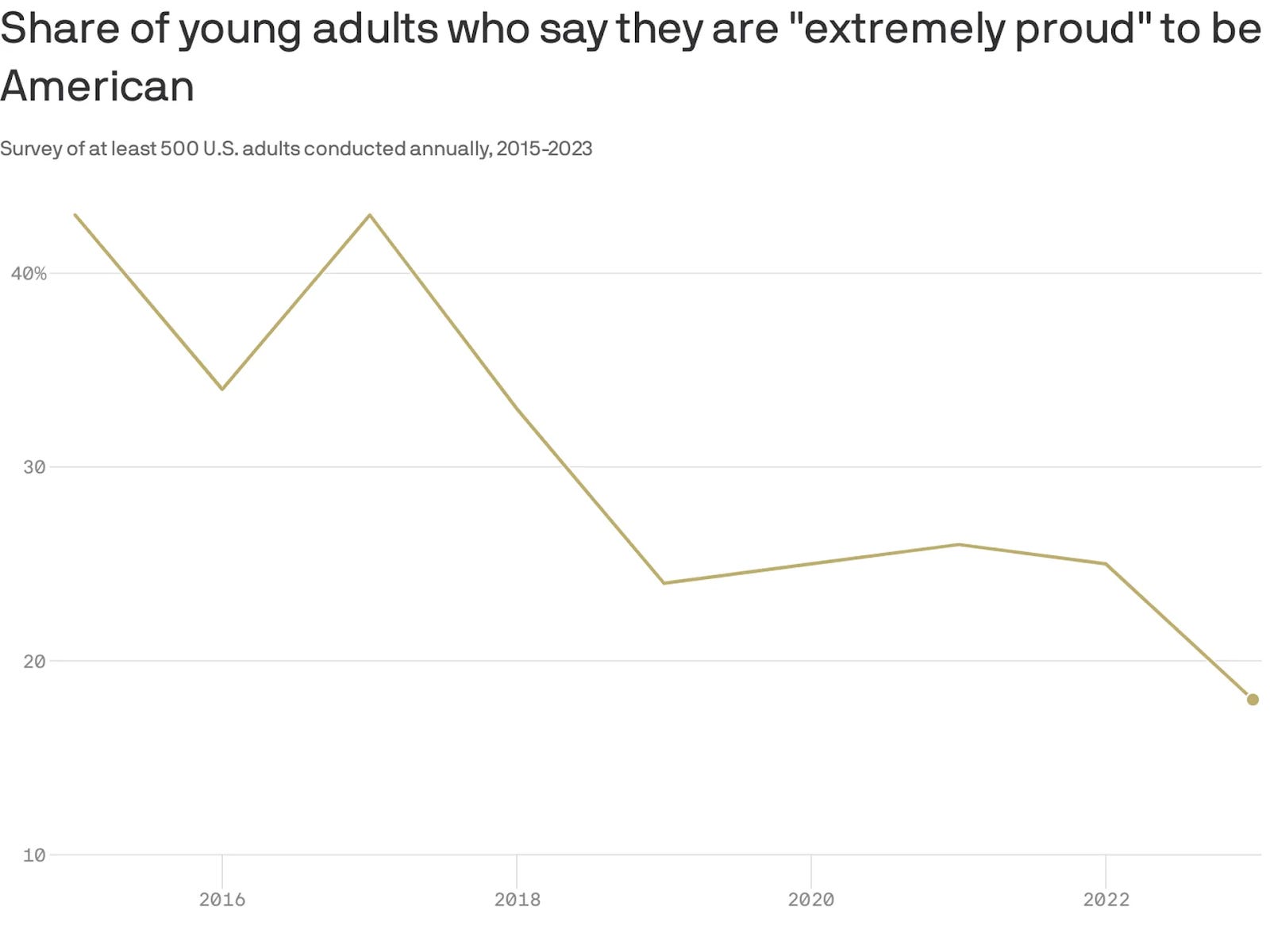
Anyone knocking doors during the 2024 presidential campaign heard loud and clear that too many Americans feel abandoned by their country’s leadership, left in the dust by the uber-rich. Huge numbers of citizens see our government as captive to the corporate titans of the donor class, serving the interests of those who can buy political influence. They are not wrong. Their despair breeds disillusionment and cynicism, most poignantly among the young: one recent survey found that only four in ten young Americans say they are proud to be American. As an ever-growing share of our nation’s wealth accumulates at the very top, capitalism departs from its democratic moorings. The facade of meritocracy is revealed as an illusion masking the reality of an entrenched oligarchy. As the veneer cracks, history shows there is a fleeting opportunity for deliberate reform before revolution brings on socialist dysfunction.
America’s unique form of capitalist democracy has saved us from revolution many times in the past. Through the banking crises of the early Republic, great panics of the late 1800s, the reign of the robber barons, the horrors of the Great Depression, and the financial crisis of 2008, our system has shown the resilience and the courage to choose reform – sometimes dramatic, wholesale reform – over revolution. A consistent motif of our history that the communists consistently failed to appreciate: Democracy has saved capitalism time and time again. When the pressure builds, our democratic form of government provides a mechanism to blow off steam before the pot explodes.
This time, we are failing. Twice, Americans have elected Donald Trump, less out of faith in him than a deep distrust in the institutions he claimed to stand against. Americans feel so alienated that they are prepared to throw out revered institutions, traditions, and even truth itself. This is a nihilistic, corrosive conviction that nothing is worth preserving; burning it all down is preferable to living under a rigged order. Left unchecked, this belief can spiral from disillusionment into rebellion.
The National Endowment offers a different way forward. It would give every American a real, material stake in the prosperity of “America Inc.” By anchoring Americans to a common source of prosperity, the Endowment would restore the sense that we’re all in this together. Opening their account every day, Americans would see tangible proof that they, too, share in the rewards of their economy. And in that shared ownership comes a renewed pride in one’s country and a reason to believe that its longevity and prosperity are inseparable from their own.
Abundance, Ezra Klein & Derek Thompson, Simon & Schuster, March 2025; Upswing, Robert Putnam & Shaylyn Romney Garrett, Simon & Schuster, September 2021; Our Own Worst Enemy, Tom Nichols, Oxford University Press, February 2023; How Democracies Die, Steven Levitsky & Daniel Ziblatt, Crown, January 2018.
We might wish they were less profit-oriented; perhaps public-minded directors would have caught on to the dirty diesel scandal of the VW Jetta before it became an international humiliation. Better oversight could have saved Volkswagen many billions in shareholder value.